
- Chronology
- Before 1500 BCE
- 1500 BCE to 500 BCE
- 500 BCE to 500 CE
- Sixth to Tenth Century
- Eleventh to Fourteenth Century
- Fifteenth Century
- Sixteenth Century
- Seventeenth Century
- Eighteenth Century
- Nineteenth Century
- Twentieth Century
- Twenty-first Century
- Geographic Area
- Africa
- Caribbean
- Central America
- Central and North Asia
- East Asia
- North America
- Northern Europe
- Oceania/Australia
- South America
- South Asia/South East Asia
- Southern Europe and Mediterranean
- West Asia
- Subject, Genre, Media, Artistic Practice
- Aesthetics
- African American/African Diaspora
- Ancient Egyptian/Near Eastern Art
- Ancient Greek/Roman Art
- Architectural History/Urbanism/Historic Preservation
- Art Education/Pedagogy/Art Therapy
- Art of the Ancient Americas
- Artistic Practice/Creativity
- Asian American/Asian Diaspora
- Ceramics/Metals/Fiber Arts/Glass
- Colonial and Modern Latin America
- Comparative
- Conceptual Art
- Decorative Arts
- Design History
- Digital Media/New Media/Web-Based Media
- Digital Scholarship/History
- Drawings/Prints/Work on Paper/Artistc Practice
- Fiber Arts and Textiles
- Film/Video/Animation
- Folk Art/Vernacular Art
- Genders/Sexualities/Feminisms
- Graphic/Industrial/Object Design
- Indigenous Peoples
- Installation/Environmental Art
- Islamic Art
- Latinx
- Material Culture
- Multimedia/Intermedia
- Museum Practice/Museum Studies/Curatorial Studies/Arts Administration
- Native American/First Nations
- Painting
- Patronage, Art Collecting
- Performance Art/Performance Studies/Public Practice
- Photography
- Politics/Economics
- Queer/Gay Art
- Race/Ethnicity
- Religion/Cosmology/Spirituality
- Sculpture
- Sound Art
- Survey
- Theory/Historiography/Methodology
- Visual Studies
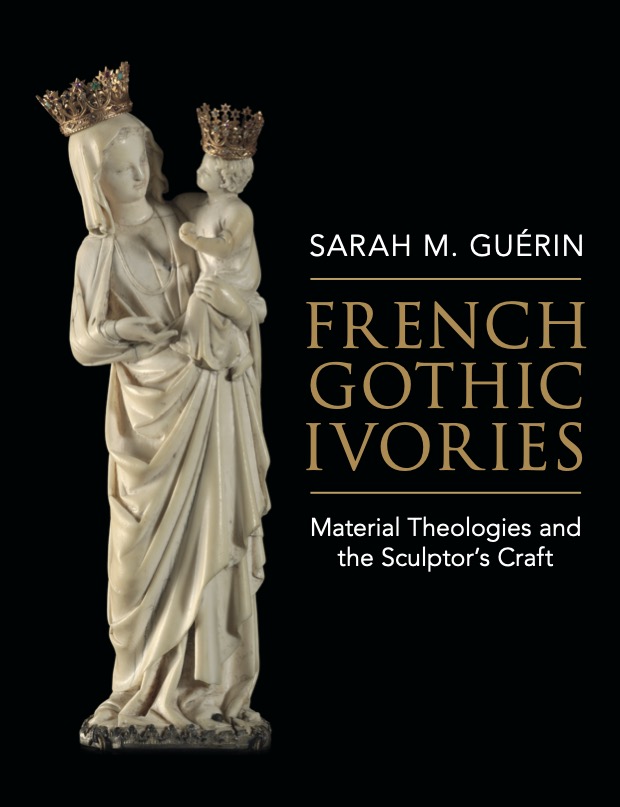
Sarah M. Guérin’s French Gothic Ivories is the first major monograph on this topic since the seminal three-volume study by Raymond Koechlin, Les ivoires gothiques français (Picard, 1924). Guérin’s book is narrower in scope, focusing on religious ivory carvings produced in Northern France and Paris between ca.1230 and ca.1330, but it is much broader in its approach. It draws on a variety of historical disciplines—social and economic history, the history of liturgy, the history of theology and spirituality, the history of medicine, and literary history—to offer a new interpretation of the rise and expansion of Gothic ivory sculpture in its first century of existence.
The introduction outlines the author’s method, rooted in and contributing to the “material turn” of art history (2). In a dialogue with Manuel DaLanda, Timothy Inglod, Michael Baxandall, James J. Gibson and Paul Binski, Guérin sets out to explore the “virtual capacities” of ivory to show how it “does not dictate specific outcomes over others, but prefers, accommodates or even resists them”, while being shaped by the “ambitions of the artist” (5–7). Six chapters follow. The first one explores the social and economic conditions that allowed for the flourishing of ivory carving in thirteenth-century Paris, explaining the mechanisms of supply, demand, and the organization of the trade. The next chapters deal each with a coherent group of artefacts that are analyzed in a loosely chronological succession: statuettes representing the Virgin and Child as the Throne of Wisdom; diptychs, triptychs, and altarpieces (of which only fragments survive) with Passion scenes; works showing the Glorification of the Virgin, either as large statuettes created for a liturgical use, accompanied by angels and inserted in small architectural frames, or as triptychs showing Mary’s Death and Assumption; smaller Marian statuettes and tabernacles for personal devotion; the production of one of the most original and prolific ivory carvers of the era, named after a triptych supposed to come from Saint-Sulpice-du-Tarn (now Paris, Musée de Cluny, inv. no. Cl. 13101). The epilogue tightly links the development of Gothic ivory carving since 1230 to the choices of the Capetian royal dynasty.
Most of the groups of objects had already been identified by previous scholarship, but Guérin in most cases, refines their dating and clarifies their precise extent. More importantly, she does not present them as isolated clusters, as in past studies, but weaves them together in a coherent narrative, explaining how the form and iconography of ivory products developed historically through the interplay of patrons’ and clients’ demands and the carvers’ ability to respond to or stimulate them, always taking advantage of ivory’s “material affordances [ . . ], that are simultaneously representational, metaphorical, and, in specific circumstances, powerfully effectual” (6).
The author builds on stylistic studies from the 1970s and on the more diversified questions addressed by scholars since the 1990s, also benefiting from the intense flowering of new enquiries in the last two decades, of which Guérin herself has been a key actor through a series of distinguished contributions that are partly incorporated in the book. She employs a variety of tools to develop her argument. Stylistic analysis and formal comparisons with a broad range of works across different media (stone and wood sculpture, illumination, goldsmith’s work) help localize and date the ivories she deals with. To shed light on the production strategies of ivory carvers, she deploys a unique ability to understand and to explain the way the tusk was apportioned and the ivory manipulated to obtain the desired result—see her analysis of how the first generation of Gothic craftsmen around 1230–40 experimented different ways to use the task to carve Marian statuettes (66–71), or her discussion of the creative and audacious procedures invented by the Saint-Sulpice-du-Tarn master (228–47). A series of enlightening diagrams drawn by Matilde Grimaldi effectively help visualize these technical explanations (figs. 6.26, 6.35). To demonstrate how the material could be used and perceived by contemporaries, an impressively wide array of sources is used: inventories, expense accounts of royal and seigneurial households, vernacular literature (46–49), medical treatises (157–59), liturgical books (162–67), biblical comments (115–18), sermons, down to little know apocryphal writings like a Picard text on the Assumption of the Virgin from the 1270s (170).
The way the material, the iconography, the composition, and the function of the works are intertwined is tightly argued, for instance, for the first Gothic diptychs (and triptychs), sculpted in Northern France around 1240: here, Guérin argues, the depicted Passion scenes resonate with the diptych form. They allude to, and simultaneously oppose, the Tables of the Law—their typological model. The ivory itself metaphorically represents the chaste and martyred flesh of Christ (91–118). The author often argues that the objects could convey complex and multilayered messages. The question of the audience and their capability to decipher such elaborate meanings is systematically addressed. A case in point is offered by the devotional statuettes of the Virgin and Child belonging to a group of women from the House of Flanders: Guérin draws attention to the importance of religious spiritual advisors as probable intermediaries of a discourse centered around and spurred by ivory artefacts. Michel de Neuvireuil (d. 1270/1), a Dominican friar active at the court of Flanders, whose career the author carefully traces, serves as a lively example of such an advisor (190–93).
Neuvireuil is just one character among the multitude of players that feature in the book. The narrative is indeed as much about artworks as about people: kings and queens, noblemen and noblewomen, bishops and monks, and of course, ivory workers. Rarely has the history of Gothic ivory carving been so vividly embodied. The story is not only about individuals, but also about networks, like the vibrant community of aristocratic women gravitating around the Clarissan sisters of Longchamp Abbey at the turn of the thirteenth and fourteenth centuries (256–61).
Craftsmen and craftswomen take pride of place in this chorus: the pages dealing with the organization of the production and marketing of ivories are highly innovative and very convincing. The role of tabletiers, the carvers of writing tablets, in apportioning the tusks for all carvers is cogently argued (33–41), as is the existence in the early fourteenth century of individuals who not only or not always directly carved the ivory, but also were “specialized in buying, selling, and repairing ivories” (59), thus contributing to shape the market at all levels. Jehan le Scelleur compellingly personifies this new kind of actor, called yvoirier (52–60). The proposal that the similarities and differences among works closely related in style and technique to the Saint-Sulpice-du-Tarn triptych can best be explained by assuming an entrepreneurial model of production, where a master outsourced the execution of part of his output to “neighborhood-based community of ivory carvers and workers in adjacent crafts” (212) is also persuasive. However, one cannot rule out the possibility that the topographical proximity may also have prompted opportunistic competitors to imitate successful types and styles. The idea that the most ambitious statuettes were carved by ymagiers (sculptors) also active in other media is equally convincing, although the documented instances of Jean de Marville and Giovanni Pisano working in ivory might not be as telling as is here suggested (38–41): one wonders if in Burgundy around 1377 or in Pisa around 1299 stone or marble sculptors were called upon for wanting of those specialized carvers that were abundant in Paris. To the suggestion that starting with the second quarter of the fourteenth century “the popularity of Gothic ivories was waning” (261) and was only shortly revived by the Valois kings and princes around 1370–1400 as they turned to their predecessors for inspiration, it could be added that in the fourteenth century the structure of the Parisian market changed also because broader and less affluent social groups were targeted and other production centers emerged elsewhere in Europe.
If some conclusions might be qualified, the overall achievement of this book is remarkable. Its formal and material qualities add to its strengths. The writing is fluid, clear, and often sparkling, so that even when the text is dense and erudite, it remains enjoyable and easy to read. The volume is beautifully produced. The numerous, high quality images accompany effectively the demonstration, even in its most technical aspects, showing for instance the back of panels to understand how the material was apportioned (fig. 3.27), or the depth of a relief to show the holes where the separately carved wings of the angels in a Dormition of the Virgin scene where originally inserted (fig. 6.22).
Sarah M. Guérin has fully integrated Gothic ivory carvings in the current discourse of medieval art history, thus both enriching wider scholarly conversation and proving the importance of these often small but major artefacts. This book will long be a reference not only for specialists of ivories, but also for anyone interested in materiality, in the production and consumption of luxury objects, in spirituality, and in the functions of devotional images during the thirteenth and fourteenth centuries.
Michele Tomasi
Full Professor of Medieval Art History, University of Lausanne, Switzerland